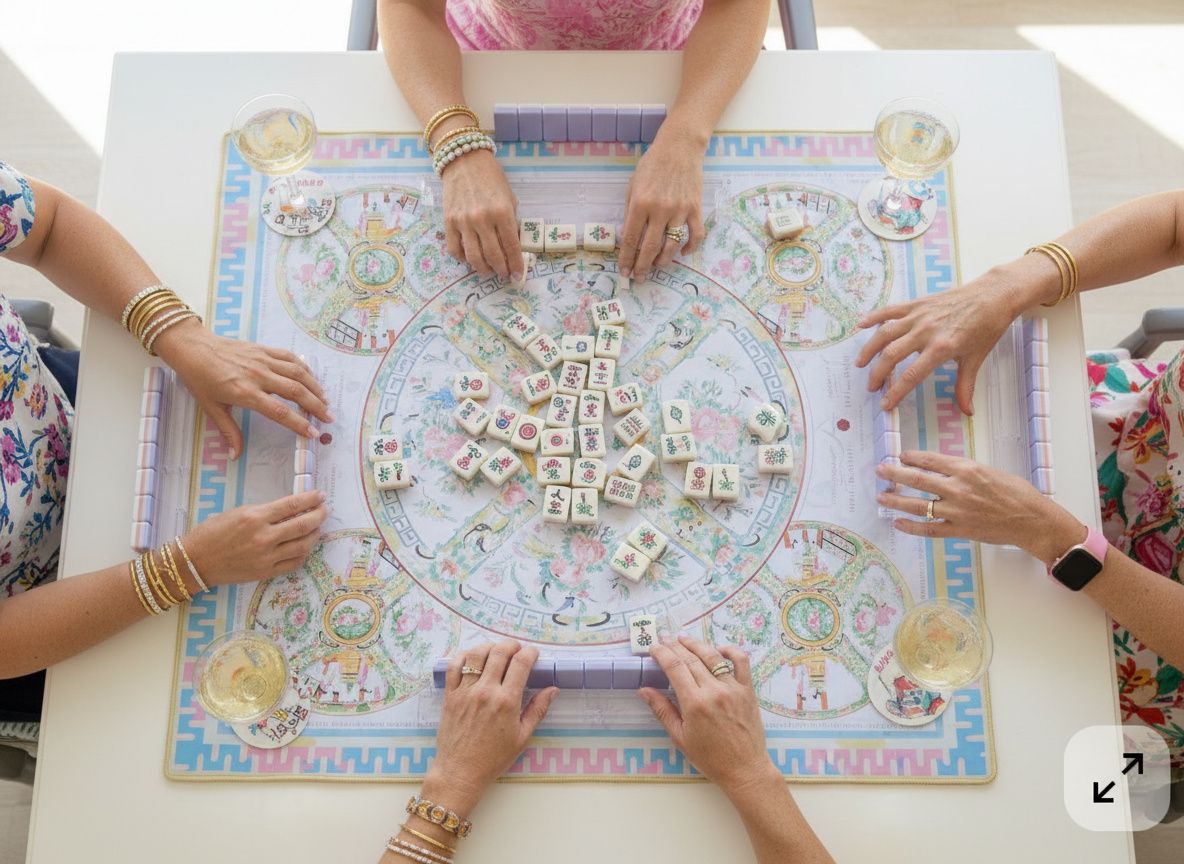
If you've ever walked past a mahjong table, heard that gorgeous clack of tiles, watched four women laughing over a card you couldn't decode, and thought "I want in"... welcome. You're in exactly the right place.
American mahjong looks complicated from the outside. From the inside, it's a tile game with a handful of simple rules and one very important piece of paper. Let's walk through all of it.
What Is American Mahjong?
Mahjong started in China in the 1800s and sailed to the U.S. in the 1920s, where it became a full-blown craze. Americans put their own spin on it, and in 1937 the National Mah Jongg League (NMJL) was founded to standardize the American game. It's been setting the rules ever since.
What makes the American version its own thing? Three words: the card, the Charleston, and jokers. More on each in a minute.
What You Need to Play
- Four players (three works in a pinch with a few rule tweaks, but four is the classic game)
- An American mahjong set: the game uses 152 tiles, including 8 jokers. Many sets ship with 160 or 166 tiles, and the extras are spares and blanks you set aside.
- Four racks to hold your tiles (most have a built-in pusher arm for the wall)
- The current NMJL card, one per player. A new one comes out every spring.
- A table, good lighting, and ideally something sparkling to sip
Meet the Tiles
- Three suits, numbered 1 through 9: Bams (bamboo), Craks (characters), and Dots. Four of each tile.
- Winds: North, East, West, South. Four of each.
- Dragons: Red, Green, and White (lovingly called "Soap"). Each dragon pairs with a suit: Red with Craks, Green with Bams, Soap with Dots. Soap also doubles as a zero in year hands, which is how "2026" gets spelled on the card.
- Flowers: eight of them, and they're all interchangeable.
- Jokers: eight wild tiles, and the most exciting tiles in the box.
The Goal
Be the first player to build a 14-tile hand that exactly matches a hand on the current NMJL card. Not close. Not "basically." Exactly. The card lists about 50-something hands, grouped into sections like 2468, Consecutive Run, and Winds & Dragons, and it changes every year.
How a Game Flows
- Build the wall and deal. Everyone gets 13 tiles; East (the dealer) gets 14.
- Do the Charleston. Before play starts, players swap unwanted tiles in a set sequence: right, across, left. Then, if everyone's game, a second round: left, across, right. Finish with an optional "courtesy" swap with the player across from you. (Jokers never get passed.)
- East discards first. Then play moves to the right: draw a tile from the wall, discard a tile, and say its name out loud.
- Claim discards when they help. You can grab someone's discard to complete a group of three or more identical tiles (a pung, kong, or quint) and set it face up on your rack. Tiles for pairs and singles can only be claimed if they win you the game.
- Call "Mahjong!" when your hand matches the card. Everyone checks it, the winner collects, and the deal passes to the right.
Jokers: The American Twist
Jokers can stand in for any tile in a group of three or more identical tiles: pungs, kongs, quints, even sextets. They can never be used in a pair or as a single tile.
The fun part: if someone has an exposed group with a joker in it and you hold the real tile, you can swap it in on your turn and take the joker. Joker swapping is where friendly tables get a little less friendly.
Beginner Tips That Actually Help
- Study the card before you play. Pick two or three hands that look approachable and learn to spot them.
- Stay flexible. Your dream hand is not coming if the tiles aren't. Pivot early.
- Watch the discards. What people throw away tells you what they're not building.
- Don't expose too early. Every group you put face up locks you into a direction.
- Be kind to yourself. Everyone has called Mahjong on a hand that wasn't. Everyone.
Keep Practicing Between Games
The fastest way to learn is lots of reps, and that's exactly why Bird Bam exists. You can practice your Charleston, your discards, and your pivots against the current card, with Bammie, our AI coach, telling you what worked and what didn't. No table required, no one watching.
Ready for the full rulebook? Our guide to American Mahjong Rules Explained in The Clubhouse covers scoring, exposures, and every edge case in between.
Start practicing with Bird Bam →